
Triton Transit Wheelchair – Folding Attendant Chair, 460mm Seat, Titanium or Burgundy
Rated to 100 kg · 11.7 kg to lift
$233.96
Member price · $259.95 without
Guides
Articles
Buying guide
First decide who pushes. A self-propelled wheelchair has big rear wheels with hand rims so the user drives it themselves; a transit chair has small rear wheels and a carer pushes it. Then match the seat width to the hips, the rating to body weight, and the frame weight to whoever lifts it into the car.
If it's only for occasional outings and someone will push, you want a light transit chair, not an expensive self-propelled one. I'm Christian; we've helped plenty of people choose these. The honest news is that a day-trips chair can cost a few hundred dollars, not a few thousand — as long as you get the seat size right.
A self-propelled chair has large rear wheels (around 24″) with push rims, so the person can move independently — but it needs reasonable arm and grip strength. A transit chair has four small wheels and is pushed by someone else; it's usually lighter and more compact, which is why it suits car travel and occasional use.
| Option | Best for | Key spec | Weight rating | Price |
|---|---|---|---|---|
 Triton Transit Wheelchair – Folding Attendant Chair, 460mm Seat, Titanium or Burgundy | Occasional outings, carer pushes — budget pick | Transit, 460mm seat, folding steel, 11.7kg | 100kg | $233.96
Member price · $259.95 without
|
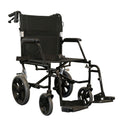 Vito Plus Transit Wheelchair – Lightweight Aluminium, 46cm Seat, Black✓ Our pick for most people | Easy lifting, carer pushes — my transit pick | Transit, 460mm seat, aluminium, 10.3kg | 100kg | $350.96
Member price · $389.95 without
|
 Breezy Basix Lightweight Wheelchair – Folding Aluminium Self-Propel, 380 to 520mm, Red | Pushing yourself, choice of seat widths | Self-propelled, 380–520mm seat, 8.3kg | 125kg | $645.26
Member price · $716.95 without
|
 Triton Folding Steel Wheelchair – 460mm Seat, Burgundy or Titanium, 120kg | Sturdy everyday folding chair | Folding steel, 460mm seat, swing-away legrests, 19.1kg | 120kg | $245.66
Member price · $272.95 without
|
 Warrior Plus Bariatric Wheelchair – 500mm to 800mm Seat, up to 315kg | Larger users needing a wide seat | Bariatric folding, 500–800mm seat widths | 160–315kg (rises with seat width) | $760.46
Member price · $844.95 without
|
 Breezy Relax Tilt & Recline Wheelchair – Self Propelled, 460mm or 510mm Seat, 140kg | Can't sit upright for long (clinical — get an OT) | Tilt-in-space + recline, 460/510mm seat | 140kg | $3,435.26
Member price · $3,816.95 without
|
My picks: for carer-pushed outings I'd take the lightweight Vito Plus Transit at about $390 — 10.3kg lifts into a boot without wrecking your back. If the user will push themselves, the Breezy Basix is a genuinely light self-propel. The Breezy Relax tilt-and-recline is excellent, but at ~$3,800 it's for a specific clinical need — don't buy it without an OT saying you need tilt.
Rated to 100 kg · 11.7 kg to lift

Rated to 100 kg · 10.3 kg to lift

Rated to 125 kg · 8.3 kg to lift

Rated to 160 kg · 39.0 kg to lift
Sit the user on a firm chair and measure across the widest point of their hips and thighs. Add about 2cm each side (roughly 4cm total) for clothing and clearance. So a 42cm hip measurement points to about a 46cm seat — the common size on the Triton Transit. Too narrow pinches and causes pressure; too wide and they slump and it's harder to self-propel.
One more measurement before you fall for a chair: the narrowest doorway it has to get through. That's usually the bathroom door or a tight hallway corner, not the front door. I'd much rather you find out here than with the chair wedged in the frame on day one.
Measure the narrowest doorway or hallway the chair has to pass through (frame to frame, in cm) and pop it in. I'll show which of these chairs clear it.
Seat depth: measure from the back of the hips to the back of the knee, then take off 2–5cm so the front edge doesn't dig in behind the knees. Seat height: feet flat on the footplates, thighs supported. If they'll also foot-propel (push along with their feet), go a touch lower.
Enter lower-leg length (back of knee to floor) to gauge a comfortable seat height.
If the user will sit for long periods, has had or is at risk of a pressure injury, can't hold themselves upright, or has changing posture, get a proper seating assessment first. The wrong cushion or seat can cause real skin damage. That's squarely clinical — I'll help with sizing and specs, but an occupational therapist should sign off on complex seating.
Lightweight aluminium chairs here start around 8–11kg — the Breezy Basix is 8.3kg, the Vito Plus Transit 10.3kg. Steel chairs weigh more but cost less, which can be fine if lifting isn't an issue.
Choose a bariatric chair with a wider seat and a higher rating. The Warrior Plus comes in seat widths from 500mm to 800mm, and its rating rises with the width — from 160kg on the narrowest to 315kg on the widest. Get the seat width right first; that's the whole point of a bariatric chair.
No. Transit chairs have small rear wheels with no push rims, so the user can't drive them. If independence matters even sometimes, start with a self-propelled chair.
A tilt-in-space and recline chair such as the Breezy Relax changes the seating angle to relieve pressure and support posture — but that's a clinical fit, so involve an OT.
Send us the user's hip measurement and we'll confirm the seat width — or see an OT for anything to do with long sitting or pressure care. Right size, right chair, bought once.
This is general guidance to help you choose equipment, not clinical advice — an occupational therapist or physiotherapist can confirm what suits you.
Let us help you find it
Help me chooseLoading questions…
Buy with confidence
Delivery quoted before dispatch.
Delivery detailsNDIS, DVA and Home Care Package.
How funding works10% off most products, every day. First month free, then $27/mo. Cancel anytime.
See membershipMinimum 12 months, handled locally.
Warranty detailsEncrypted Shopify checkout.
Mon–Sun 9am–6pm (Sydney time). Ask before you buy.
Call now Australian owned
Sourced from specialist healthcare manufacturers and their Australian distributors.


Standard price
Member price
That's back in your pocket
Then $27/mo after your free first month · cancel anytime