
Buying guide
Walking frame vs rollator vs walking stick: which mobility aid do you need?
A walking stick suits mild balance issues or one weaker side; a walking frame gives the most stability but you lift or shuffle it a step at a time; a rollator rolls on four wheels with brakes and a seat for people who keep moving but need to lean and rest.
- Australia-wide delivery
- Members save 10%
- Genuine brands
“Dad's a bit wobbly — does he need a stick, a frame or one of those wheely things?”
It depends on how much support he needs and where he walks. I'm Christian — my background is a Bachelor of Medical Science, with years working in pharmacies and the disability sector. The trick is to buy for the support he needs now, not the worst-case day — you can always step up later.
A 30-second self-check
- Can you walk steadily with light support in one hand? A walking stick is probably enough.
- Do you need both hands and a rock-solid base, mostly indoors? A walking frame.
- Can you keep moving a fair way but need to stop and sit? A rollator.
If two of these sound like you on different days, buy for the harder day — but no further.
How do the three compare?
Mobility aids compared (prices approx., October 2026)
Tap a column heading to sort · prices are live| Option | Best for | Key spec | Weight rating | Price |
|---|---|---|---|---|
 Standard Handle Cane | Mild balance or one weaker side | Single cane, handles 76–99cm, 0.2kg | 120kg | $19.76
Member price · $21.95 without
|
 Small Base Quad Cane with TPR Handle | A bit more stability, still one hand | Four-point base, stands on its own, 70–94cm | 100kg | $22.46
Member price · $24.95 without
|
 Folding 2-Button Walking Frame | Maximum stability, slower, indoors | Pick-up frame, no wheels, 2.8kg | 136kg | $80.96
Member price · $89.95 without
|
 1-Button Walking Frame with 3" Wheels | Stability with less lifting | 3" front wheels, rear glides, 76–93cm | 112kg | $60.26
Member price · $66.95 without
|
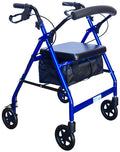 6" Wheel Aluminium Rollator | Keeping moving and resting often | Four wheels, brakes, seat, 6.7kg | 110kg | $140.36
Member price · $155.95 without
|
My honest take: a surprising number of people buy a $150 rollator when a $22 cane or a $90 frame was all they needed. If Dad's steady enough for a stick, start there — it's lighter, cheaper and less to manage. Step up only when the stick stops feeling safe.
When is a walking stick enough?
If you're mostly steady but want light support, or you favour one side. A T-Shape Handle Cane is light and adjustable; a quad cane adds a wider base and stands on its own, which helps if your grip or balance is weaker.
Sticks and canes


Small Base Quad Cane with TPR Handle
Rated to 100 kg · 0.8 kg to lift
$22.46
Member price · $24.95 without

When should I choose a walking frame?
When you need firm support with both hands and feel safest when the frame isn't rolling away. A pick-up frame like the Folding 2-Button Walking Frame is the most stable option, but you lift it each step, so it suits shorter trips indoors. Add front wheels (the 3″-wheel version) to cut the lifting while keeping a stable base.
Walking frames

Folding 2-Button Walking Frame
Rated to 136 kg · 2.8 kg to lift
Currently out of stock
$80.96
Member price · $89.95 without


1-Button Walking Frame with 3" Wheels
Rated to 112 kg · 2.3 kg to lift
$60.26
Member price · $66.95 without
When is a rollator the better choice?
When you can walk a reasonable distance but tire or wobble and need to rest. It rolls without lifting, has locking brakes and a seat. If that's you, our rollator buying guide goes deeper.
How do I size any of them?
Same rule for sticks, frames and rollators: the grip sits at your wrist height when you stand up straight. Measure floor to wrist crease in your usual shoes, set the grip there, elbow bent only slightly. A cane that's too long is the most common sizing mistake — and it's a trip hazard, not just uncomfortable.
Enter your standing wrist height to see the grip height to aim for across sticks, frames and rollators.
cm
When should I stop and see a professional first?
If the wobbliness is new, getting worse, or comes with dizziness, recent falls or surgery, that's not a shopping problem — it's a reason to get a falls assessment. An OT or physio can work out why balance has changed and which aid is safe. I sell equipment; I don't diagnose, and neither should a website.
Paying with NDIS, DVA or aged-care funding?
Independent sources worth a look
Questions & answers
Is a rollator safer than a walking frame?
Not automatically. A pick-up frame is more stable because it doesn't roll, but it needs more effort and decent arm strength. A rollator is easier to move but you must understand the brakes. The safest choice depends on your balance and strength — when in doubt, get it assessed.
Can I use a walking stick in either hand?
A standard cane works in either hand; most people hold it on the stronger side, opposite the weaker leg. Some orthopaedic-handle canes are shaped for a specific hand, so check before you buy.
What if I'm between a frame and a rollator?
A wheeled walker with front wheels and rear glides sits neatly between the two — more mobile than a pick-up frame, more stable than a four-wheeled rollator.
Which is best indoors versus outdoors?
Pick-up and wheeled frames shine indoors; rollators with larger wheels win outdoors. Our outdoor guide covers this.
Not sure which way to go?
Tell us the situation and we'll point you to the simplest aid that's safe — often the cheaper one. Or see an OT first if balance has changed recently. Getting the right type beats getting the fanciest one.
This is general guidance to help you choose equipment, not clinical advice — an occupational therapist or physiotherapist can confirm what suits you.
Let us help you find it
Help me chooseLoading questions…


