
Buying guide
Commode buying guide: bedside commode vs over-toilet frame vs shower commode
If the walk to the toilet is the problem, you want a bedside commode. If getting up off a low toilet is the problem, you want an over-toilet frame or a raised seat. If washing is the problem too, a wheeled shower commode does both. Match the seat height to the person's legs and the weight rating to their body, and you've made 90% of the decision.
- Australia-wide delivery
- Members save 10%
- Genuine brands
“The toilet's become a battle — which commode do I actually buy?”
Short answer: a “commode” is just a chair you can toilet on, and the three types solve three different problems. A bedside commode brings the toilet to the room when the walk is too far or too risky. An over-toilet frame sits over your existing toilet to lift you higher and give you arms to push up on. A shower commode is a wheeled, waterproof version that rolls over the toilet and into the shower. I'm Christian; I hold a Bachelor of Medical Science and have spent years working across pharmacies and the disability sector, so let me take the jargon out of it.
One question that sorts most people in 30 seconds
Before you look at a single model, ask: what is the hard part?
- Getting to the toilet — especially at night, or if the bathroom is up a step or down a hall. That's a bedside commode.
- Getting up off the toilet — the pan is too low and there's nothing to push on. That's an over-toilet frame (or a raised toilet seat with a rail).
- Both, plus showering sitting down — that's a mobile shower commode that wheels between the two.
Answer that honestly and the type picks itself. Everything below is detail.
What actually matters when you choose a commode?
Four things decide comfort and safety. Get these right and the brand barely matters.
- Seat height — feet flat on the floor, knees roughly level with the hips. Too high and the feet dangle; too low and standing up is a fight. Most adjust in a useful range; a few are fixed, so check.
- Width between the arms — wide enough to sit comfortably, close enough to push up on. Measure the person's hips across the widest point and add a little.
- Weight rating (safe working load) — a sensible margin above body weight, not miles over. For heavier users, step up to a 200–250kg frame rather than hoping.
- Where it has to go — a bedside unit needs to fit beside the bed and, if wheeled, through the doorway; a shower commode needs to clear your toilet bowl and roll into the shower recess.
Who needs a bedside commode?
A bedside commode earns its place when the trip to the bathroom is the risk — half-asleep, in the dark, or along a hallway that's too far when someone's weak or unsteady. Most falls at home happen on that night-time toilet trip, so removing it entirely is one of the highest-value things you can do.
The Bedside Chair Commode is my steady pick: a seat that adjusts from 46 to 63.5cm, arms to push up on, and a 150kg rating, around $250.95 (approximate, as at November 2026). If budget is tight or you only need it for a few weeks of recovery, the Folding Steel Commode folds flat for storage, is rated to 100kg and sits around $86.95 — just note its seat is a fixed 41cm, which suits shorter users better.
Who needs an over-toilet frame instead?
If the person can still get to the bathroom but struggles to lower onto and rise from a standard pan (they're low — around 40–42cm), an over-toilet frame is the simpler, cheaper answer. It sits over the toilet, raises the effective seat height and gives you two arms to push up on.
The Wide Aluminium Over Toilet Aid adjusts from 43 to 60cm, is rated to 140kg and weighs just 4.05kg, around $139.95. If you want a fixed surround that frames the toilet with tall handles rather than a seat, the Toilet Support Steel Frame gives handle heights of 69.5–82cm and a 112kg rating for about $90.95. For heavier users, the 200kg Bariatric Over Toilet Aid keeps the same idea at a 200kg rating.
When is a mobile shower commode worth it?
A wheeled shower commode is for when someone needs to be wheeled to the toilet and showered sitting down — usually where a carer is involved, or the bathroom and toilet are a journey apart. It's the dearest option and the most equipment to store, so only go here if you genuinely need the wheels.
The Heavy Duty 3-in-1 Shower Chair Commode is a clever middle ground: it works as an over-toilet frame, a bedside commode and a shower chair, adjusts 49–59cm, is rated to a hefty 250kg and weighs only 5.5kg, around $334.95. If you specifically need castors and brakes to roll it, the Stainless Steel Mobile Shower Commode Chair has a 50cm seat, castor brakes and a 150kg rating, around $468.95.
Which commode would I actually buy? Real options compared
Commodes compared (prices approximate, November 2026)
Tap a column heading to sort · prices are live| Option | Best for | Key spec | Weight rating | Price |
|---|---|---|---|---|
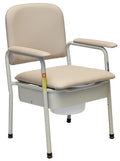 Bedside Chair Commode | Night-time toileting by the bed — my default | Seat 46–63.5cm, 11.5kg, steel | 150kg | $225.86
Member price · $250.95 without
|
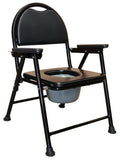 Folding Steel Commode | Short-term recovery, tight storage | Fixed 41cm seat, folds flat, 7.25kg | 100kg | $78.26
Member price · $86.95 without
|
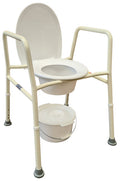 Wide Aluminium Over Toilet Aid | Rising off a low toilet | Seat 43–60cm, just 4.05kg | 140kg | $125.96
Member price · $139.95 without
|
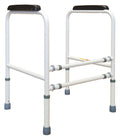 Toilet Support Steel Frame | A surround with tall push-up handles | Handles 69.5–82cm | 112kg | $81.86
Member price · $90.95 without
|
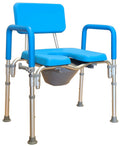 Heavy Duty 3-in-1 Shower Chair Commode | One frame for toilet, bedside and shower | Seat 49–59cm, 5.5kg | 250kg | $301.46
Member price · $334.95 without
|
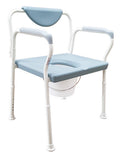 Heavy Duty Aluminium Commode | Heavier users wanting a light frame | Seat 42.5–60cm, 6.4kg | 225kg | $211.46
Member price · $234.95 without
|
If I were buying for a parent who's steady by day but unsafe on the night-time walk, I'd get the bedside chair commode and leave the toilet itself alone. If the only problem is rising off the pan, I'd spend a third of that on the over-toilet aid plus a fixed rail and call it done. I would not buy a wheeled shower commode unless someone actually needs to be rolled — that's money better kept.
My everyday picks

Wide Aluminium Over Toilet Aid
Rated to 140 kg · 4.0 kg to lift
$125.96
Member price · $139.95 without

Heavy Duty 3-in-1 Shower Chair Commode
Rated to 250 kg · 5.5 kg to lift
$301.46
Member price · $334.95 without

How do I get the seat height right?
This is the one measurement that makes or breaks a commode. Sit the person on a firm chair with their feet flat: you want their knees roughly level with their hips and their heels able to tuck slightly back under them, because that's the position you push up from. Measure from the back of the knee to the floor (in their usual footwear) and set the commode seat to match.
Pop in the lower-leg length (back of knee to floor, in usual shoes) and I'll show the seat height to aim for and which commodes cover it.
cm
Common mistakes — and when cheaper is absolutely fine
The ones I see most:
- Buying a wheeled shower commode when a $140 over-toilet aid would do. Wheels are only worth it if someone's being transported.
- Ignoring the seat height. A commode the feet can't reach is a commode nobody uses safely.
- Guessing the width. Too narrow is uncomfortable and unsafe; too wide and there's nothing to push on. Measure the hips.
- Trusting a suction rail as the main support. Fine as a light steadier, never as the thing you'd stake a fall on.
Paying with NDIS, DVA or aged-care funding?
Where to get independent help
Questions & answers
What's the difference between a commode and an over-toilet frame?
A commode is a standalone chair with a removable pan you can toilet on anywhere in the room. An over-toilet frame has no pan — it sits over your existing toilet to raise the height and add arms. Many modern frames, like the 3-in-1, do both jobs.
What seat height should a commode be?
Set it so the person's feet are flat and their knees are about level with their hips when seated. For most adults that lands somewhere between 45 and 55cm, but measure from the back of the knee to the floor to be sure. Several of our commodes adjust across that range.
How much weight can a commode hold?
Our standard commodes are rated 100–150kg, which suits most people. For heavier users, the Heavy Duty Aluminium Commode is rated to 225kg and the 3-in-1 to 250kg. Choose a sensible margin above body weight rather than the biggest number.
Can a commode go in the shower?
Only a purpose-built mobile shower commode, which is waterproof and rolls on castors. A standard steel bedside commode is not made to get wet repeatedly. If you need to toilet and shower from the one seat, choose a shower commode or a 3-in-1.
Do I still need a grab rail if I have an over-toilet frame?
Usually yes, and the two work best together. The frame gives you arms to push up on; a properly fixed wall rail gives a fixed point to steady the turn. Have a rail fitted into a stud or with proper fixings rather than relying on suction.
Still not sure?
If you tell us the person's height, hip width and what the hard part is — getting there, or getting up — we'll tell you honestly which one to buy, and when a cheaper option or a short-term loan is the smarter call. Call us on (02) 9125 4293 or use the fit check on any product. No one ever regretted getting the sizing right.
This is general guidance to help you choose equipment, not clinical advice — an occupational therapist or physiotherapist can confirm what suits you. Prices and specifications mentioned are approximate and as at November 2026; the live product cards show the current price.
Let us help you find it
Help me chooseLoading questions…


